The exhibition ,,Mircea Carp. A life in the service of freedom’‘ is a project of the National History Museum of Romania, realized together with the Carp family, the designer and photographer Octavian Bâlea, the family of Colonel Gheorghe Cojocea, the family of Colonel Ioan Mexi, the RoMilitaria Association and the Union of Professional Journalists of Romania. The exhibition project is organized on the occasion of the one century anniversary of the birth of the officer and journalist, on the 28th of January 2023.
His family
Family history had a major influence on Mircea Carp and his development. Originally from Iași, he is a descendant of two families that gave the country important political leaders and military commanders, who through their decisions influenced the unfolding of important historical events. His father, Constantin Carp, a cavalry Colonel and World War I veteran, was a role model. Devotion, will and selflessness, qualities that defined the character of a roșiori (cavalry) officer, were adopted and assumed by his son. His fatherly image and advices were to remain with him throughout his life as a future journalist. His mother, Ecaterina Carp, was the person who, through care, affection and dedication, contributed to the balance of the family and the home. Ecaterina Carp was a constant support, even during the long period of exile, when the Carp family was away from the country, to which she remained absolutely devoted.
His dream
Since childhood, Mircea Carp wanted to pursue a military career and become an officer. This goal motivated him to attend the ,,General George Macarovici’’ Military High School in Iași between 1936 and 1940 and the ,,Nicolae Filipescu’’ Military High School between 1940 and 1942. The young military pupil developed a special attachment to the institution founded at the initiative of the conservative minister and to the values that defined the ,,mănăstirean’’ spirit.
Military career
Between June 1942 and May 1944, as a scholarship student of the Romanian state, he attended various military schools in Germany to become a tank officer (6th Tank Regiment at Neuruppin bei Berlin in Brandenburg; Active Mechanized Officers School at Gross Gliencke). In the summer of 1943 he served his internship on the Eastern Front with the 10th Tank Regiment (20th Tank Division). From March to May 1944 he served as a Second Lieutenant instructor at the 18th Tank Regiment (Dresden). Returning to the country in June 1944 he was assigned as a Second Lieutenant instructor at the Tank Training Subcentre, part of the Motorized Training Centre in Târgoviște and joined a group of officers working on improving the design of the Marshal tank destroyer. After the change of alliance in August 1944, as an officer of the Armoured Detachment ,,Colonel Matei”, he took part in the military actions near Otopeni, Mediaș, Câmpia Turzii, Carei and on the territory of Hungary. For his military merits he was decorated with the National Order „Crown of Romania” in the rank of knight, with swords and „Military Virtue” ribbon. Mircea Carp had the misfortune of many career officers who were excluded from the army, after the entry into force of Law No. 433 from the 9th of August 1946, for the transfer to the reserve. In August 1947 he was arrested, in the tense context in which the communist political regime was trying to consolidate its power. Thus Mircea Carp entered the category of anti-communist political detainees, having experienced imprisonment in the basements of the Ministry of the Interior, at the Prefecture of the Capital Police and at Văcărești Penitentiary. After his release, the cavalry officer decided to settle in the West to continue the fight against an illegitimate and oppressive regime. After his 25th birthday, at the end of January 1948, Mircea Carp went into exile, first to Hungary and then to Salzburg in Austria, where he began collaborating with the American authorities in the field of intelligence.
His career in SUA In 1951 he went to the United States, working first for the Committee for a Free Europe and later for Radio Voice of America, as announcer, editor and later deputy head of the Romanian Service. Mircea Carp stood out for his commitment, objectivity, responsibility and qualitative work, as well as being the journalist who consecrated the words „Let’s hear only good things!” as a form of greeting that gave Romanians confidence during the difficult years of communism and the transition period. In 1969 he returned to Romania as part of the delegation that accompanied Richard Nixon, the first American president to make a state visit to Romania. His first return was part of a series of 14 visits he made as a special correspondent for Radio Voice of America, reporting with great professionalism on the realities of his homeland.
In 1978 he accepted to continue his activity at Radio Free Europe in Munich, as responsible for the „Political Program” and the program „Romania and Human Rights”, reaching his professional peak after 5 years, when he was appointed assistant director, with the attributions of deputy director of the Romanian section. During this period he had a close collaboration, based on mutual trust and respect, with leading names of the Romanian press in exile: Noël Bernard, Vlad Georgescu, Mihai Cismărescu, Emil Georgescu, Monica Lovinescu, Cornel Chiriac, etc. If for the Romanians, Europa Liberă represented the most important and reliable source of information, for the representatives of the communist regime in Romania, the radio station represented a feared adversary, an opposition organization, whose members had to be silenced.
His retorning in Romania
After 1989 he returned to the Romania frequently, participating in numerous events aimed at commemorating those who opposed the political regime imposed by the USSR, being a supporter of the Sighet Memorial of the Victims of Communism and Resistance. At the same time he collaborated with numerous publications, in particular with ,,Memory, the journal of arrested thought’’. A professional of the written word, not only of the spoken one, Mircea Carp has published 3 books of memoirs, the most recent in January 2023.
Awards His merits were recognized by the awarding of the National Order „Star of Romania” in the rank of Commander on the 1st of December 2020 by President Emil Constantinescu and the Cross „The Royal House of Romania” on the 25th of March 2015 by King Mihai I. Through deeds, words, courageous actions, but especially through patriotism, Mircea Carp, also known as Dan Mircescu and Mihai Șoimu, has achieved the consecration and place he deserves, both in the history of Romania and in the hearts of Romanians.
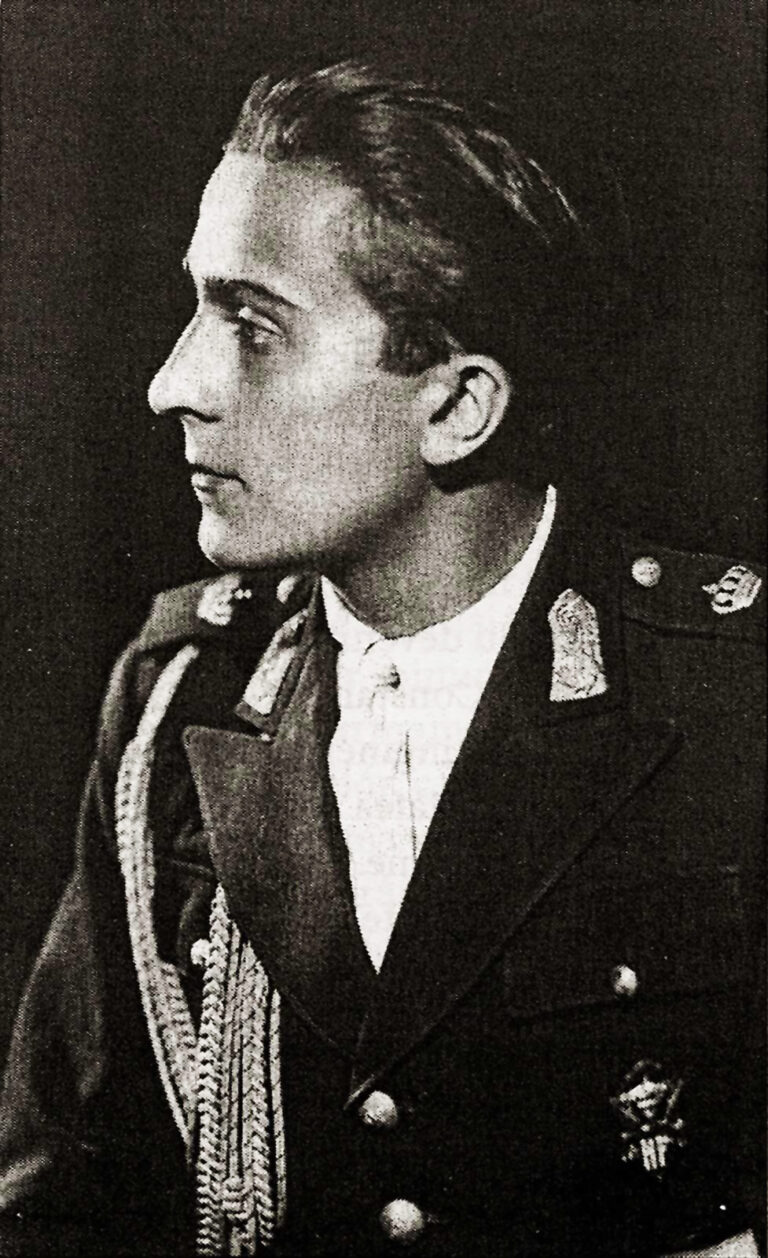
Mircea Carp, pupil of the Military High School ,,Nicolae Filipescu'' from Dealu Monastery, early 1940s
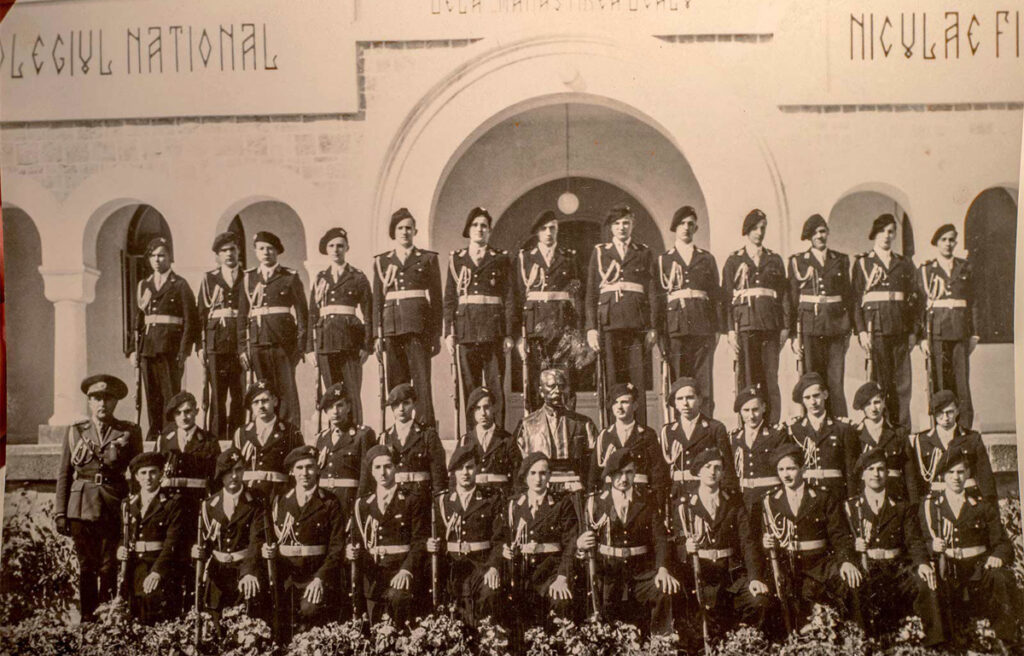
Pupils of Class 27, early 1940s.
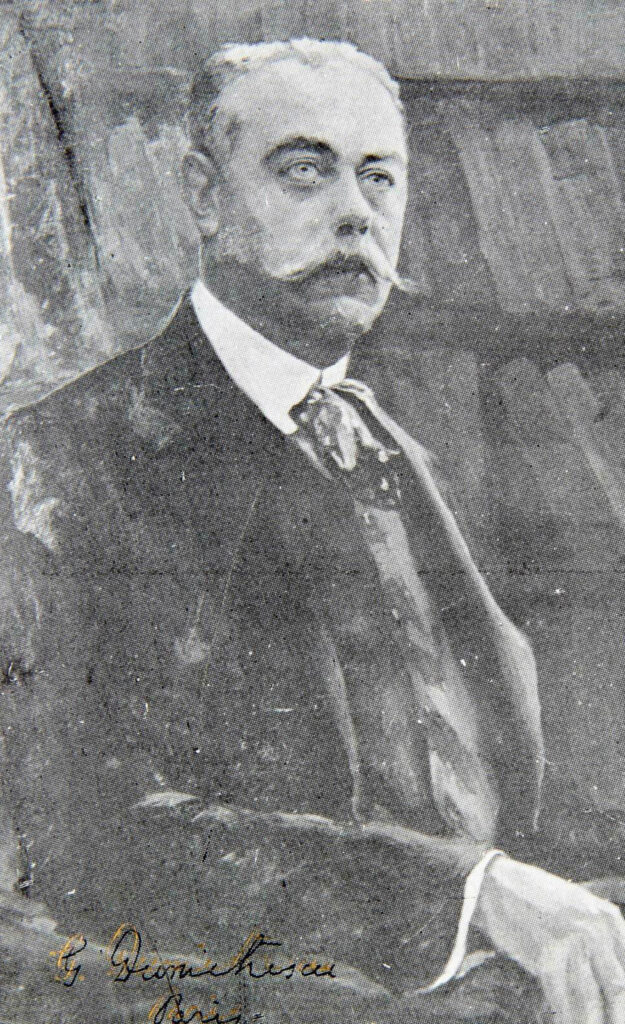
Nicolae Filipescu, prominent member of the Conservative Party and founder of the Dealu Monastery Military High School.
Organization of the exhibition:Octavian Bâlea, Flavius Nicolae Roaită (curator) Partners: familia domnului colonel Mircea Carp, familia domnului colonel Gheorghe Cojocea, familia domnului colonel Ioan Mexi, Asociația RoMilitaria și Uniunea Ziariștilor Profesioniști din România, doamna Carmen Grigoraș. Photography and photo scanning: Octavian Bâlea, Luciana Ghindă Graphic design: Octavian Bâlea
Petre P. Carp (1837-1919), Ambassador, Minister of Foreign Affairs and President of the Council of Ministers (collection of NHMR).
Lascăr Catargiu (1823-1899), Minister of Defence and President of the Council of Ministers. (Wikipedia).
Corneliu Carp (1895-1982), commander of the 5th and 8th Cavalry Divisions, deputy to the Chief of the General Staff in 1945 (collection of the Carp family).
Paul Teodorescu (1888-1981), Commander of the Superior War School, Minister of Air and Navy (collection of the NHMR).
Union Square in Iași at the end of the 19th century (collection of the NHMR).
Mircea Carp with his mother Ecaterina in Sibiu, early 1930s (collection of the Carp family). Mircea Carp mit seiner Mutter Ecaterina in Sibiu, Anfang der 1930er Jahre (Sammlung der Familie Carp).
A beautiful photograph of the Carp family, Bucharest 1934 (collection of the Carp family).
Mircea Carp with his father, Constantin Carp, Lieutenant-Colonel at the 3rd Cavalry Regiment in Chișinău, 1927 (collection of the Carp family).
Distinctions that were awarded to officer Constantin Carp, participant in the Second Balkan War and the First World War (photo credit Octavian Bâlea).
Constantin Carp, cavalry Lieutenant-Colonel in ceremonial uniform, 1930s (collection of the Carp family).
,,General George Macarovici'' Military High School, Iași, interwar period (collection of the NHMR).
,,Nicolae Filipescu'' Military High School from Dealu Monastery, moved to Predeal in the building that had been used by the Straja Țării organization, early 1940s (collection of Roaită Flavius Nicolae).
Mircea Carp photographed in his first year of studies at ,,General George Macarovici'' Military High School in Iași, 1936 (collection of the Carp family).
Young military pupil Mircea Carp with career officer Constantin Carp (collection of the Carp family).
Ioan Mexi, graduate of the class of 1941, good friend and comrade of Mircea Carp (collection of Colonel Ioan Mexi).
,,Nicolae Filipescu'' Military High School from Dealu Monastery, perspective from the heroes' monument and the tower with a belfry, 1930s (collection of Roaită Flavius Nicolae).
Church dedicated to Saint Nicholas from Dealu Monastery, 1970s (collection of Colonel Ioan Mexi).
Mircea Carp, pupil at the ,,Nicolae Filipescu'' Military High School, early 1940s (collection of the Carp family).
Pupils during outdoor classes, 1941 (collection of Colonel Ioan Mexi).
Officers, teachers and pupils of the college, taking part in a religious ceremony in Predeal, 1941 (collection of Colonel Ioan Mexi).
Graduates of military high schools selected to attend active military officer schools with German instructors and officers during their visit to Potsdam, on the main stairs of Sanssouci Palace on the 21st of June 1942 (collection of Colonel Gheorghe Cojocea).
In a moment of rest during training in the garrison of the 6th Tank Regiment in Neuruppin bei Berlin. In the front row from left to right are Gheorghe Cojocea, Alexandru Neicov, Mircea Carp. On the next row: Ion Nohai, Ovidiu Haidamac, Radu Iliescu, summer 1942 (collection of Colonel Gheorghe Cojocea).
Panzer III, Ausf. C, combat technique on which Mircea Carp was trained to fight (collection of Colonel Gheorghe Cojocea).
Gheorghe Cojocea, good friend and comrade of Mircea Carp, during his military studies in Germany, 1943 (collection of Colonel Gheorghe Cojocea).
Mircea Carp, Second Lieutenant instructor at the 18th Tank Regiment in the spring of 1944 (collection of the Carp family).
Mircea Carp, cavalry officer who proudly wears the Order of the Crown of Romania, in the rank of knight with swords and ribbon of Military Virtue, Falcon Badge of the ,,Nicolae Filipescu'' Military High School and Tankman Badge, 1946 (Carp family collection).
Mircea Carp, Second Lieutenant at the Cavalry Training Centre in Sibiu, 1946 (Carp family collection).
Church of Văcărești Monastery, interwar period (collection of the NHMR).
Mircea Carp photographed with his mother at the end of the war (Carp family collection).
Palace of the Ministry of Interior, second half of 1940 (Willy Pragher).
Appraisals of senior officers for Mircea Carp, from his personal file (Carp family collection).
Appraisals of senior officers for Mircea Carp, from his personal file (Carp family collection).
Appraisals of senior officers for Mircea Carp, from his personal file (Carp family collection).
Document attesting the transfer of Second Lieutenant Mircea Carp from the Sibiu Mixed Training Centre to the Bucharest Territorial Circle, 1947 (Carp family collection).
Palace of the Prefecture of Police of the Capital, 1940s (www.bucurestiulmeudrag.ro).
Cathedral of Saints Rupert and Virgil in Salzburg, first half of the 20th century (Austrian State Archive).
Panoramic view of Salzburg, first half of the 20th century (Austrian State Archive).
Old Market Square and Town Hall, first half of the 20th century (State Archive of Austria).
Mircea Carp photographed in Salzburg, September 1948 (collection of the Carp family).
Heidi Meyerweissflog, with whom Mircea Carp started a family (collection of the Carp family).
Mircea Carp with Ioana Razi in studio 10 of Radio Voice of America, 1960 (collection of the Carp family).
Portrait photograph of President Richard Nixon, given with dedication to Mircea Carp, 1970s (collection of the Carp family).
Mircea Carp and Mike Hanu before a radio broadcast, 1958 (collection of the Carp family).
Mircea Carp while reporting on a U.S. Air Force tanker crew at Omaha Air Force Base, Nebraska, July 1958 (collection of the Carp family).
Mircea Carp, with two representatives of the Romanian community in Pittsburgh, Pennsylvania, early 1960s (collection of the Carp family).
Mircea Carp, together with the appreciated film actor Kirk Douglas, 1960 (collection of the Carp family).
Mircea Carp, special correspondent of Radio Voice of America, waiting for the arrival of US President Richard Nixon at ‘’Henri Coandă’’ International Airport, Otopeni, 2nd of August 1969 (collection of the Carp family).
Mircea Carp, on the day of his appointment as head of the Romanian Service of Radio Voice of America, with his colleagues, 1970 (collection of the Carp family).
Document sent by the Timiș County Inspectorate of the Ministry of the Interior to the Third Counterintelligence Directorate of the Securitate, concerning the pursuit and sabotage of Radio Vocea of America journalists Mircea Carp and Ron Pemstein, 15th of April 1978 (collection of the Carp family).
Document sent by the Timiș County Inspectorate of the Ministry of the Interior to the Third Counterintelligence Directorate of the Securitate, concerning the pursuit and sabotage of Radio Vocea of America journalists Mircea Carp and Ron Pemstein, 15th of April 1978 (collection of the Carp family).
Portrait photo, early 1980s (collection of the Carp family).
Barbu Mihail Cismărescu, chief news editor and director (December 1981 - February 1983) of the Romanian department of Radio Free Europe. He died on the 26th of February 1983 of a rampant cancer (collection of the Carp family).
Vlad Georgescu, director (February 1983 - November 1988) of the Romanian department of Radio Free Europe. Died on the 13th of November 1988 of a rampant cancer (collection of the Carp family).
Emil Hurezeanu and Octavian Paler during a radio broadcast, early 1990s (collection of the Carp family).
Mircea Carp speaking at the meeting of the Romanians Abroad Organization, Bucharest 1992 (collection of the Carp family).
Mircea Carp, speaking at a meeting of graduates of the ,,Nicolae Filipescu’’ Military High School, organized by Colonel Ioan Mexi at Dealu Monastery, early 2000s (collection of Colonel Ioan Mexi).
The certificate by which Emil Constantinescu, President of Romania, awarded on the 1st of December 2000, the National Order Steaua României in the rank of Commander, to Mircea Carp (collection of the Carp family).
The certificate by which Emil Constantinescu, President of Romania, awarded on the 1st of December 2000, the National Order Steaua României in the rank of Commander, to Mircea Carp (collection of the Carp family).
Patent by which King Michael I presented Mircea Carp with the Cross of the Royal House of Romania, 25th of March 2015 (collection of the Carp family). Mircea Carp, after the decoration ceremony held at Peleș Castle in Sinaia, 25th of March 2015 (collection of the Carp family).
Mircea Carp, after the decoration ceremony organized at the Peleș Castle in Sinaia, March 25, 2015 (Carp family collection)
Mircea Carp, tank officer and war veteran, photographed in front of a Panzer IV, model J, during the cultural event Days of the National Military Museum, 9th of May 2015 (photo credit Sebastian Radu).
Mircea Carp, speaking at a meeting of graduates of the ,,Nicolae Filipescu’’ Military High School, organized by Colonel Ioan Mexi at Dealu Monastery, early 2000s (collection of Colonel Ioan Mexi).
Keepers of German military traditions presenting honours to Mircea Carp, during the cultural event Days of the National Military Museum, 9th of May 2015 (photo credit Sebastian Radu).
Mircea Carp with his family: Thomas, Sandra, Emma, Mihai and Merete, 2017 (collection of the Carp family).
Mircea Carp with his grandson Thomas and his son Mihai, 2021 (collection of the Carp family).
Portrait photographs of journalist Mircea Carp at the age of 100, taken with a Leica M6 camera with APO-summicron 90 mm, on Ilford film, 25th of March 2023 Munich. Photo credit: Octavian Bâlea.
Portrait photographs of journalist Mircea Carp at the age of 100, taken with a Leica M6 camera with APO-summicron 90 mm, on Ilford film, 25th of March 2023 Munich. Photo credit: Octavian Bâlea.
Portrait photo of journalist Mircea Carp at the age of 100, taken with a Stenopeika camera with Rodenstock 300 mm. lens and orthochromatic emulsion, 25 March 2023 Munich. Photo credit: Octavian Bâlea.
Mircea Carp with Gabriela Carp, Romulus Rusan and Banu Rădulescu in Munich, 1996 (Carp family collection)
Pentru a oferi cea mai bună experiență, folosim tehnologii, cum ar fi cookie-uri, pentru a stoca și/sau accesa informațiile despre dispozitive. Consimțământul pentru aceste tehnologii ne permite să procesăm date, cum ar fi comportamentul de navigare sau ID-uri unice pe acest site. Dacă nu îți dai consimțământul sau îți retragi consimțământul dat poate avea afecte negative asupra unor anumite funcționalități și funcții.
Funcționale
Mereu activ
Stocarea tehnică sau accesul sunt strict necesare în scopul legitim de a permite utilizarea unui anumit serviciu cerut în mod explicit de către un abonat sau un utilizator sau în scopul exclusiv de a executa transmiterea unei comunicări printr-o rețea de comunicații electronice.
Preferințe
Stocarea tehnică sau accesul este necesară în scop legitim pentru stocarea preferințelor care nu sunt cerute de abonat sau utilizator.
Statistici
Stocarea tehnică sau accesul care sunt utilizate exclusiv în scopuri statistice.Stocarea tehnică sau accesul care sunt utilizate exclusiv în scopuri statistice anonime. Fără o citație, conformitatea voluntară din partea Furnizorului tău de servicii de internet sau înregistrările suplimentare de la o terță parte, informațiile stocate sau preluate numai în acest scop nu pot fi utilizate de obicei pentru a te identifica.
Marketing
Stocarea tehnică sau accesul sunt necesare pentru a crea profiluri de utilizator pentru a trimite publicitate sau pentru a urmări utilizatorul pe un site web sau pe mai multe site-uri web în scopuri de marketing similare.
Luni – Marți : închis
Miercuri – Duminică: 10.00 – 18.00
Magazinul muzeului se închide la: 17:15
Adresa
Calea Victoriei 12, Sector 3, București 030026, România
Vă invităm să vizitați cele trei mari expoziții permanente – Tezaurul Istoric, Copia Columnei lui Traian și Lapidarium – precum și o serie de expoziții temporare.